

know thyself.
on the personality-industrial complex, the many types of love, and why no quiz will ever tell you who you are -- in which i make the case that “to thine ownself be true” was always a group project.

acknowledgements:
- to the friends who have tried to figure me out: thank you for trying, and then staying long enough to get it right. thank you for the years you've spent doing the slow, intentional work -- for knowing the coffee order and the worried-voice version of my name, for loving me in your own dialect. you are the only personality test i've ever actually trusted. may we always afford the same city, or the flight, or at the very least the discord call -- and may floortime always have room for one more.
- to anyone, reading this with a half-finished personality quiz open in another tab: i see you, because i am you. thank you for wanting to be known badly enough to go looking for it, even in all the strange places. may you not need to in the days to come.
- to those who mapped us long before us: to the greeks and their whole fistful of loves, to lewis and aristotle and vonnegut, to the amateur mystic mothers -- thank you for the words when all i had was ambiguos feelings. thank you for reference points worth borrowing, and worth outgrowing. may we keep the good parts and compost the rest, as i think you'd have wanted.
A friend I love is telling me what I am.
We’re on their floor, they’re running through the personality archetype gauntlet, and I’m fascinated by it.
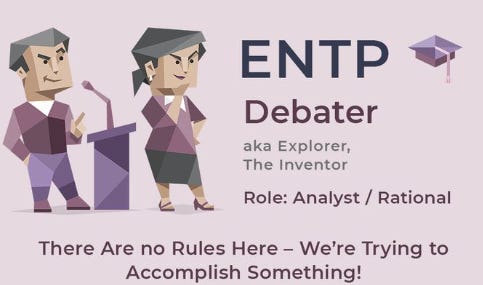
There’s never enough good furniture at this age we can afford to fill a room, as I’m sure you know, so there I was on the ground, solo cup in hand -- and she has a particular gleam, “You’re such an Eight,” said warm as anything. “Or a 7w8. Or an ENTP, obviously, look at you.”
And here’s the embarrassing part, the part I’d rather pretend isn’t true: something in my chest relaxes. Oh. Okay. So that’s what I am. Finally, validation. Thank you.
…Because she said what the many, many online tests I’d taken over the years also said.
(So it must be true, right?)
I love that feeling of relief, of being known and validated. That confirmation, the ease of it. Because it’s such a relief, isn’t it? To be handed the answer. To be told.
We are, I’m fairly certain, the most sorted, typed, indexed, and cross-referenced generation in the entire history of humanity, all of it. We have our four letters and our single digit with a wing, our attachment style and our love language and our rising sign, even our Spotify Wrapped read back to us every November like a tarot spread. We have never in human history had access to so many mirrors, and so many fragmented reflections. (Or, to stretch the metaphor game: so many puzzle pieces that all kind of fit, but in many different ways.)
And I don’t think we’ve ever been systematically designed to be less sure of the faces looking back from them either.
aside: I feel obligated to mention, before I get too high on my own faux-contempt, that I have taken all of these. Repeatedly. Sometimes twice in a night, to get a better, more accurate, answer. Which is, if you sit with it for even one second, crazy of me. Honorable mention: the ever iconic buzzfeed “Am I Gay?” quizzes that Im pretty sure always say “YAS”.
Here’s the joke of it beyond all the mirrors, though; one that bothers me perhaps more than it should:
The instruments we’ve handed our souls to were mostly built by amateurs and showmen. The Myers-Briggs, those four letters half your coworkers keep in their email bios, was made by a mother and daughter -- Katharine and Isabel -- with exactly zero training in psychology, statistics, or anything adjacent to either. (Isabel’s degree was in political science; she wrote mystery novels on the side.) They built it in the 1940s to sort the women flooding into the wartime workforce into their proper jobs, and their first real client was a literal spy agency. SPY AGENCY. Its whole theoretical spine is bent out of a book by Carl Jung -- who, for the record, cautioned against using his types as rigid boxes, which is of course the only way anyone has ever used them… because we’re western humans, we love rigid boxes. (It makes the world so much more manageable and less scary, no?)
And in 1948, a psychologist named Bertram Forer gave his students a personality test and then handed each of them a tailored profile. They rated it, on average, 4.26 out of 5 for accuracy. Uncanny. Except every last student had gotten the identical paragraph, which Forer had quietly cobbled together out of a newsstand astrology book. One of the lines was: you have a great need for other people to like and admire you.
Which -- yeah. Guilty. Aren’t you? That’s the trick, and it’s a very old one. Faux stripmall psychics play off of the same idea too, that specific concept is called cold reading. The art of personalizing the obvious so specifically it feels like it could only apply to you. A la fortune cookie (no hate of course. by all superstitious means please tell me my future or swap my body with someone elses.)
That is to say, we’ll accept nearly any mirror, from nearly any hand, so long as it flatters us with the sensation of being specifically, uniquely seen, validated, and/or known.
Not even genuinely, it just has to activate the sensation, to feel like it.
So it’d be easy to stop right here. Do the tidy little debunk, feel briefly pretentious, inform you the tests are fake, log off. But, naively, I love the tests still. It’s fun, if nothing else. and perhaps you still might want to take them? and perhaps this has so far come across as a holier-than-thou judgement on people wanting resources to understand themselves better? …and that’s it!
I don’t actually think you’re ignorant or wrong for wanting them. I think you’re starving. I think we’re all starving. And I think I know exactly what for.
Because the hunger is real even where the answer is vague nothingness. Self-knowledge got genuinely, by design, harder to come by this century, and not because we got dumber. The old scaffolding that used to tell a person who they were -- the inherited faith, the town that watched you grow up and had loud opinions about it, the fixed job you’d hold until it buried you, the heteronormative eurocentric nuclear family ideals, the tidy script for what a life was supposed to do -- has thinned out to almost nothing. And for some of us it was never load-bearing to begin with. If you were the queer kid, the first in your whole bloodline trying to just be you, the one whose life had no template because nobody in the family photo albums ever got to attempt it -- there was never a script. There was an old page of doodles and ink blotches and scrapbook materials left to make something of.
Meanwhile, at the exact same time, we have more arbitrary structure than any humans who have ever lived. Something is always telling us what to buy, when to sleep, how to feel, who to be, why to be, when to be. We are over-instructed and under-known. Over stimulated and under appreciated. Told constantly. Understood by the powers that be almost never.
So of course we grab the quiz. Of course we do. The alternative -- finding out who you are the slow way, out in the actual complex world, in the immutable haze of actual other people, over a span of years none of us are entirely certain we’ll be granted -- is expensive, and frightening, and vertigo inducing, and does NOT fit inside even 50 lunch breaks. The four letters are a loan. We’re borrowing against a self-knowledge we haven’t done the living to earn, and paying it back at interest, in disappointment, in investment lost, every time the box turns out not to hold us.
But here. Here’s the part I came across while writing this, and the part I actually want to give us, because I think it’s the good part:
Notice which reference points actually help.
The self-tests -- Myers-Briggs, the enneagram, the four humours before them (bless the medieval doctors who figured your entire personality was just a question of which fluid you were currently sloshing with) -- all do the same thing. They sort you in a vacuum. Here is what you are, alone, in a sealed room, as though a person were a fixed object you could hold still long enough to correctly label forever.
And then there are the other frameworks. The ones that stuck, and stuck for a reason.
The Greeks, rather famously, didn’t have one word for love (and I LOVE this philosophy, for the record. I think of it often). They had a fistful, the Greek Loves:
- Eros: the wanting kind, the passion, desire-filled, consuming kind. The appreciation of beauty in a person, as Plato said.
- Philia: the deep comradely love of your actual friends, the ones who’d help you move a body or, at minimum, a couch. It’s dispassionate, but virtuous. Brotherly love, essentially.
- Storge: the fond hum of familial closeness you barely notice as it’s so natural; quite literally natural empathy. The love of parents, siblings, cousins. It’s also, from my understanding, kind of like obligatory love. Nationalism, sports teams, kings, etc.
- Agape: the big terrifying open-handed affection you must give freely, unconditionally. Charity, the Love of your God(s). “Willing the good of another” (said by Thomas Aquinas, not me. lol.)
- Ludus: love as play, as flirtation, as just a good time. Flirting, bantering, uncommitted romantic thrill. Not necessarily intimate.
- Pragma: the seasoned enduring love that’s less “falling for someone” than standing for someone, on purpose, for decades. Patience, compromise, mutual respect rather than passion. A lot of married folks with recognize this as “the choice to show up every day and make the relationship work.”
- Philautia: Love of the self, as a fundamental necessity for well being. Self-respect, boundaries, personal growth, meeting needs, appreciating your worth. But also, at times, selfishness and ego-driven obsession. A desire for status, vanity, personal gain.
- Xenia: guest-friendship, hospitality. The generous, ritualized bond between a host and a stranger. Inherently ephemeral, but also quite beautiful. This is the “proper rules of hospitality” love. Providing a guest with food/shelter/bathing/safe escort and as a guest being gracious, offering a gift in return, not abusing generosity.
Did I have to go into them in detail? No, but I love the concept a lot, and I think a lot more modern people could learn quite a bit from practicing each of them intentionally. Also, thinking about them is what spawned the idea for this article, so… works cited.
You’ll probably recognize a structure to them, even if you weren’t familiar before.
The modern, distilled approximation is the five love languages.
I’m sure you know them, but I’ll repeat them here anyways for the sake of symmetry:
- Words of Affirmation: compliments, deep appreciation, and explicit encouragement.
- Quality Time: undivided attention, deep conversations, and shared device-free experiences.
- Physical Touch: physical connection like holding hands, kissing, and hugging, PDA, etc.
- Acts of Service: Action-oriented gestures that ease responsibilities or lighten workloads, making someone elses life easier.
- Receiving Gifts: Thoughtful, visual tokens of affection representing effort and care. Often signatures of time and effort and thoughtfulness.
What you might not know is that they were invented, I’ll be honest with you, by a Baptist marriage counselor, and are roughly as rigorous as a fortune cookie. They caught fire amongst religious circles first as “clean, ethical ways to life your life” and would not go out. Each, of course, corresponding to a different kind of sanctioned, clean-cut, distinct relationship. Ask yourself why those spread, while the humours went to die in a museum.
I’ll tell you why. Because not one of them is about you alone.
This is not to cast doubt upon them by any means, it actually highlights an important point to the power of it:
Each one is a reference point aimed at the space between two people. They don’t ask what am I. They ask the better, in their context, question: how do I love, and how do I need to be loved back. The useful mirror was never the one you hold up to your own face in an empty room. It was the one angled to catch somebody else in the frame. You and them, as reference points to each other- because the truth must be somewhere in between.
Which brings me, of course it does, back to the oldest instruction we’ve got:
Know thyself. Carved into the stone at Delphi, over the temple of an oracle, twenty-five centuries ago -- and we have spent basically all of those centuries treating it as a solo assignment. A thing you do alone with your own mind. (“to thine ownself be true.”) Or, lately, alone with a quiz at one in the morning.
But I’ve come to think that’s a mistranslation of the entire spirit of the thing.
It wasn’t supposed to be, in its original context, instructions on what to do- it was actually a maxim, serving as a humbling reminder for mortals (us, you included presumably) of their own limitations.
Like: you cannot actually find out who you are by yourself. It isn’t in there waiting to be found by looking harder, to be dug away at. The self isn’t a sealed jar with a label you keep failing to read. It’s more like a shape that only shows up in reaction -- you learn your own outline by the space you take up in/with/for other people. Aristotle called a friend another self, and I don’t think he was being cute about it. I think he meant it structurally. You are, in some real part, assembled out of the people who bother to know you. (Patchwork people, all borrowing pieces from each other- but that’s for another article another time.)
This is not to say there is no self to be known in aloneness, to be sure. It’s just a different self, different momentum, different references.
Digression, because I can’t help myself: Vonnegut (RIP!) coined two words for this that I think about often. A granfalloon is a false team -- a group that feels like belonging but signifies nothing: everyone who shares your star sign, your Hogwarts house, your four letters, your alma mater’s football team. Then there is a karass, which is your real pals, the handful of people you’re genuinely, cosmically tangled up with, doing some inscrutable work together whether or not you ever understand it. And the thing about a karass is: you can’t find yours by taking a test. There’s no quiz. You find it by living, failing at times, forward, until one day you look up and there they are and you couldn’t tell anyone when it happened or for why.
The personality type is a granfalloon. The people on whose floor you’re sitting communally are a karass. Learn the difference and you’ve learned nearly the whole thing. Boom, TL;DR done.
"Hello, babies. Welcome to Earth. It's hot in the summer and cold in the winter. It's round and wet and crowded. At the outside, babies, you've got about a hundred years here. There's only one rule that I know of: 'God damn it, you've got to be kind.’"
- Kurt Vonnegut, anti-war moralist & humanist.
So here’s what I think the tests are actually for, and why we can’t put them down: they’re fast, and the real thing is slow. The quiz hands you an answer tonight. The people who genuinely know you take years to render even part of the picture -- and half of us are scattered three time zones deep, doing the grim arithmetic on whether we can afford flights to see each other, not over Discord or Facetime this year. The fast thing is right there, a few clicks away and free (generally). The slow thing costs your whole life and does not come with a shareable graphic or cute little art piece.
But the slow thing is the only thing that has ever actually worked.
You don’t find out who you are from four letters. You read about it, then find out if it’s true from those who you keep showing up for, and who -- miraculously -- keep showing up for you. The only love language that ever told you something true was never one of the official five. It’s the illegible private one your people invented themselves: the untranslatable dialect of one specific chosen family. The inside joke that’s just a noise now, but still means something. The exact coffee order or birthday somebody memorized without being asked. The particular way they say your name when they’re worried about you. That’s the real personality inventory. It takes your entire life to complete. It will never, not once, hand you a clean four-letter result. Dare I say, nor should it. We’re better off this way, I think.
Thank God for that, honestly. I don’t want to be a granfalloon. I want to be known -- the long way, by more than name or type or humour or house.
So take the quiz, if you want to. I will too, probably, the next time I feel like a stranger in my own home yet again, which is more often than I’d care to print. But maybe view the results with a little more description and a little less prescription. And maybe let the better questions be the ones you fall asleep with tonight -- not who am I, tidy and typeable and finished by tomorrow, but the harder ones, the ones that takes real people and real time and cannot be answered alone:
who do am I showing up for? who knows me? who am i letting know me?
and -- damn, even the scarier one --
what am i?
this piece was brought to you by: Blaine Greenway.
ENTP, Type 7w8, Sanguine, Ravenclaw, Existentialist, Analyst Debater, Promoter, Extraversion, White Chocolate Mocha Picture Perfect w/ Caramel Pump + Caramel Drizzle & Whip Cream, etc.
[EPIGRAPHS & INSPIRATIONS]
“I am larger,
better than I thought;
I did not know I held
so much goodness.
All seems beautiful
to me.”
- Walt Whitman, Song of the Open Road.
“Friendship is unnecessary,
like philosophy, like art...
It has no survival value;
rather it is one of those things
which give value to survival.”
- C.S. Lewis, The Four Loves.
“I'll get scared and you'll get bored
It's the only conclusion my mind can form
You'll say goodbye and I'll apologize
For not being strong enough to ever realize that
I don't know anything about anything anymore
And you don't know anything about me
(because I won't let you)”
- Speak Low If You Love, A List of Things.
“There are all kinds of love in this world,
but never the same love twice.”
- F. Scott Fitzgerald, Tender is the NIght.
[FAVORITE TUNES WHILE WRITING]
Hold On When You Get Love & Let Go When You Give It, Stars.
Pull Me In, Paper Lions.
Scott Pilgrim Vs. My GPA, Mom Jeans.
Am I Ever On Your Mind?, D.A Stern.
Words, Gregory Alan Isakov.
I Think You Were In My Profile Picture Once, Modern Baseball.
Moon Song, Phoebe Bridgers.
Love, Love, Love, Of Monsters & Men.
Don’t Delete The Kisses, Wolf Alice.
Just Like Heaven, The Cure.
There is a Light That Never Goes Out, the Smiths.
I Miss Your Warm Hands, i don’t like mirrors.
House Song, Searows.
I’ll Believe in Anything, Wolf Parade.